DEGENERATION OF SEX IN FUNGI
In lower group of fungi, sexual reproduction is acomplished by elaborate sexual process through the development of gametangia, production of gametes and union of gametes to produce zygote. In lower group of phycomycetes, the sexual reproduction is typically isogamous, anisogamous and oogamous. In higher group of phycomycotina, Ascomycotina and basidiomycotina the sexual process proceed in an altogether different direction of proceess but the sexuality is still preserved. This gradual simplification of sexual process from lower group to higher group in fungi is called "Degeneration of Sex" in fungi.
Degeneration of sex means functional and structural degeneration of sex organs leading to simplification of the process and not the degeneration of sexuality. This phenomenon is termed as "Simplification of sexual reproduction" rether than "Degeneration of sex". Thus in highly envolved members like basidiomycetous fungi, there is no sex organs highest degree of sexuality is still prevailing.
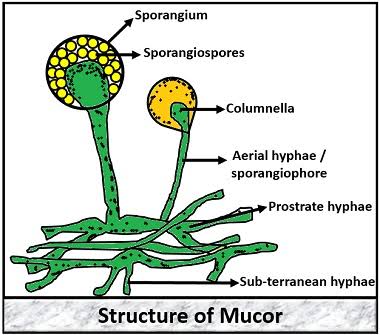
The class oomycetes of phycomycotina represents fairly advanced type of sexual reproduction i.e, oogamy. In oomycetes oogonia and Anthredia are developed, the result of sexual fusion or fertilization is the formation of oospore or zygote which is invested by a thick wall. In the class zygomycetes the sexual reproduction is through gametangial copulation. The sexual reproduction in Mucorales takes place by means of conjugation of two similiar gametangia of different physiological strains (+ and -) , still exhibiting dioecious nature of the hyphae.
In Ascomycotina, typical oogamous reproduction is noticed in some members, e.g., pyronema spp. In such fungi ascogonium and anthredium are formed and the union between the two organs takes place. After association between sex nuclei in the oogonium, ascogenous hypha bud out in which each cell contains male and female nuclei. The ascogenous hypha produce ascus which in turn produce ascospores by reduction division.
In different members of the class Discomycetes of Ascomycotina, there is a gradual and progressive deterioration of sexual process leading to a simple method of sexual reproduction. The anthredium first underwent a functional degeneration and finally structural degeneration. In Aspergillus herbariorum the anthredium is present but functionless. In some members of Ascomycotina such as Collema pulposum, the formation of anthredium no longer takes place instead the union takes place between the oogonium and some asexual spores like conidia, Oidia, etc. In Humaria grandula, the union takes place between oogonia and somatic hyphae. Ultimately, in Humaria rutilens, the union takes place between the two somatic hyphae which are sexually distinct.
In Basidiomycotina, no trace of sex organ is present. However, In basidiomycetous fungi, the union takes place between hyphae of sexually distinct strains leading to plasmogamy. Nuclear association takes place in the cells of dikaryotic Mycelium in case of hetrothallic Mycelium.
Thus in Basidiomycotina the function of sex organs is acomplished by monokaryotic Mycelium. The sexual procees is extremely simplified but the nuclear fusion is still maintained.







0 Comments
If you have any query let me know.